Arduino AKX00075 - An SDK for HMI Applications
The Arduino Due provided Arduino users with a wide array of GPIOs. The Arduino Giga offered a more advanced microcontroller, while its display shield addressed HMI needs. Now, all of these products are combined into an affordable getting-started kit.
Announcements at Arduino Day 2025 clearly show that the Italian process computer powerhouse sees its niche in creating easy-to-use starter kits for industrial prototyping. Given that even humble coffee machines now come with a fully graphical display, a high-powered system with an attractive display is helpful.
Arduino Giga-Wi-Fi Means STM32 and Lots of GPIO Pins
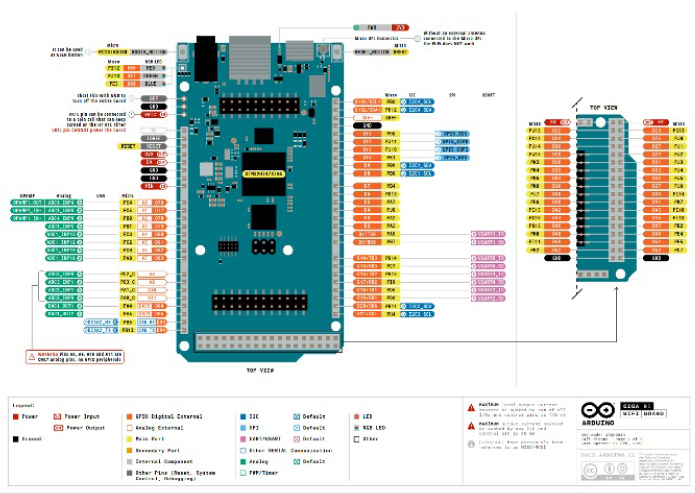
Component number one of the bundle is the Arduino Giga Wi-Fi, more commonly known under its SKU ABX00063. It is the successor of the above-mentioned Arduino Due and comes with an STMicroelectronics STM32H747XI processor that reaches a maximum speed of up to 480 MHz. In fact, the chip has a second core---this means that a microPython and a C-based Arduino application can be hosted in parallel.
From a technical point of view, the unit is compatible with its predecessor, A000062. Circuit designers need to be careful to appreciate that the new board works only with 3.3 V signals.
In addition, some of the connectors were provided with additional hardware-accelerated peripherals. In total, three I2C ports, two SPI ports, and one CAN FD interface are spread across the pinout, thereby connecting to a variety of sensors and interfaces.

A Display Shield Is Needed for Additional Interface Possibilities
The second component is the Arduino Giga display shield, commonly known by its SKU ASX00039. It mounts on top of the Arduino Giga, creating a solid display assembly for HMI tasks.
The touchscreen display is 4 inches in diameter and has a resolution of 800×480 pixels. It works with 16-bit color depth; the touchscreen driver can track five points simultaneously and is also capable of detecting touchscreen gestures for advanced, multitouch-like interaction.
In addition to the display capability, the board also includes a BMI270 IMU and an MP34DT06JTR microphone. These provide additional sensor information, which can be useful for all kinds of ML-based assistant tasks.
Comfortable Software Ecosystem for Fast Development
One reason for Arduino\'s tremendous success is the availability of the Arduino IDE alongside its hardware abstraction layer: once the (simple to use) API has been mastered, Arduino-based code can be run on a variety of systems.
The AKX00075 perfectly supports both of its components---getting started is as easy as putting the two components together and launching the Arduino IDE on the workstation of choice.
Conclusion
If a high-interactivity HMI device needs to be prototyped, the AKX00075 is an excellent first step. Its microcontroller provides ample compute power and more than enough residual memory, while the display is great for both prototyping and final use. In short, it\'s a bundle everybody should know and use.