Brainboxes PE-515 – Industrial Ethernet’s Finest Switch
Ethernet has taken the world of industrial networking by storm. If a device needs an internal unmanaged ethernet switch capable of connecting up to five devices, the Pure Embedded PE-515 is the go-to solution.
Electrical engineers who are thinking about how to network components usually select from a set of embedded networking methods. While these work well for sensors and similar applications, transferring large amounts of information across them can be interesting.
Falling back to Ethernet is, in many ways, a safe method: not only can the protocol reliably handle up to 100 MB per second, but it is also natively supported in most SOCs. Furthermore, signal integrity requirements are relatively loose compared to other digital buses operating at a similar speed.
Connecting more than two devices requires an Ethernet switch. Using an off-the-shelf switch is challenging, as these often struggle with environmental robustness. Furthermore, mounting them inside an embedded device can be a challenge. Finally, product availability for consumer and prosumer-grade hardware is not particularly long-lived. Deploying the PE-515 provides a much safer and more efficient solution.
A Minuscule, Credit-Card-Sized Ethernet Switch
The Pure Embedded PE-515 presents itself, as shown in the figure. The red ports are responsible for the individual Ethernet connections, while the two additional ports are used for uplink and power supply.
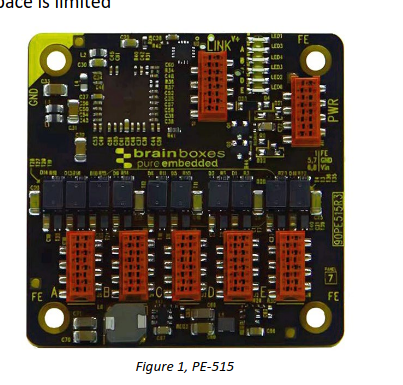
The system at hand has various aspects that endear it to electrical engineers. Firstly, its size of just 55 x 55 mm and its minuscule weight mean that the impact on the physical dimensions of the resulting embedded system is small. Furthermore, the temperature range of -40°C to +80°C / -40°F to +176°F matches that of high-quality components, reducing the need to deal with the thermal management of the Ethernet part of the solution.
In terms of power, the switch can make do with 3.3 watts. The power supply, furthermore, spans a flexible range of 3.3 to 5 VDC. This means that the high voltages required to power consumer-grade switches are not needed---in a modern, low-power design, this often leads to the complete elimination of one stage of the power supply.
Finally, BrainBoxes backs its PE-515 with a wide availability guarantee: as of this writing, the design's stability is guaranteed until at least 2034, with an extension probable if enough demand is generated by clients.
Flexible Connector Options Simplify Ethernet Integration.
Consumer and office Ethernet networks usually use an RJ45 type cable. While well-known and well-liked, these jacks can be relatively complex. In the case of the PE-515, Brainboxes provide a variety of connector options and are compatible with connectors from Wurth and TE Connectivity.
In particular, the data sheet recommends the part numbers 690 357 280 476 and 338728-4 for surface mount. If a through-hole connector on the host is preferred, the numbers 690 357 100 472 or 215464-4 should be used. If a board-to-wire interface is best suited to the task at hand, the 690 157 000 472 connector can be used. In the case of TE, the product supports both the 215083-4 and 338095-4 connector SKUs.
Developers seeking to prototype a system based on the Brainboxes Ethernet IP are well-advised to purchase the evaluation board, available under the SKU PE-405. It breaks out the interfaces found on the switchboard and provides easy access to the signaling LEDs and support interfaces.
The PE-505 SKU is available for systems that can work with just one hundred megabits of bandwidth. It provides a more cost-effective version of the board.
Conclusion
If an industrial or IoT system must connect multiple Ethernet noses inside its case, deploying the Brainboxes product family is an excellent decision. The product is easy to integrate from a mechanical point of view, has outstanding electrical and ambient resistance properties, and - last but not least - is backed by a long-term availability guarantee. In short, it is a product that every electrical engineer should know.