ESP32-P4 – a non-Wi-Fi ESP32 microcontroller
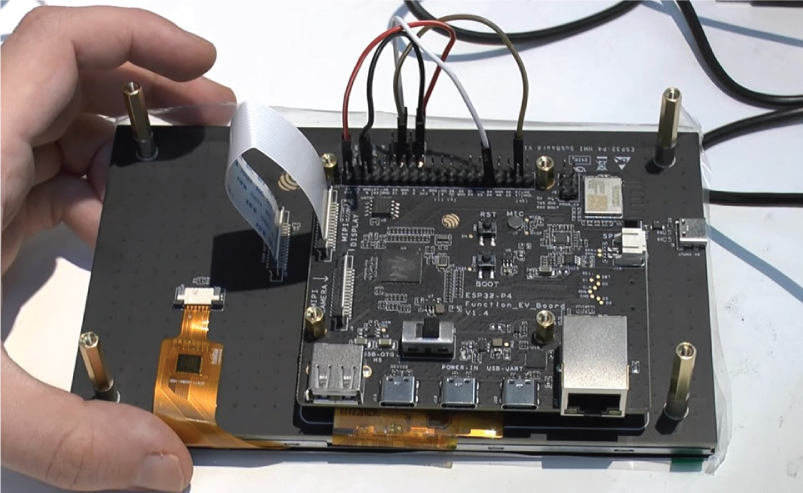
Espressif’s ESP32 platform established itself as the go-to chip for applications where a general-purpose microcontroller is to be combined with a wireless radio. With the ESP32-P4, Espressif provides a new chip which forgoes the wireless transmitter for increased compute capacity.
Due to the ease of programming provided by ESP_IDF, developers often use the ESP32 family of chips in applications where a wireless transmitter is surplus to requirements. Instead, many of these applications - a good example would be the AI tests demonstrated by the ESP-EYE family of smart cameras – benefit from additional computer resources, ideally with a vast amount of external memory to host model information. The ESP32-P4 is Espressif’s answer to this demand.
Two high-speed RISC/V cores for compute performance
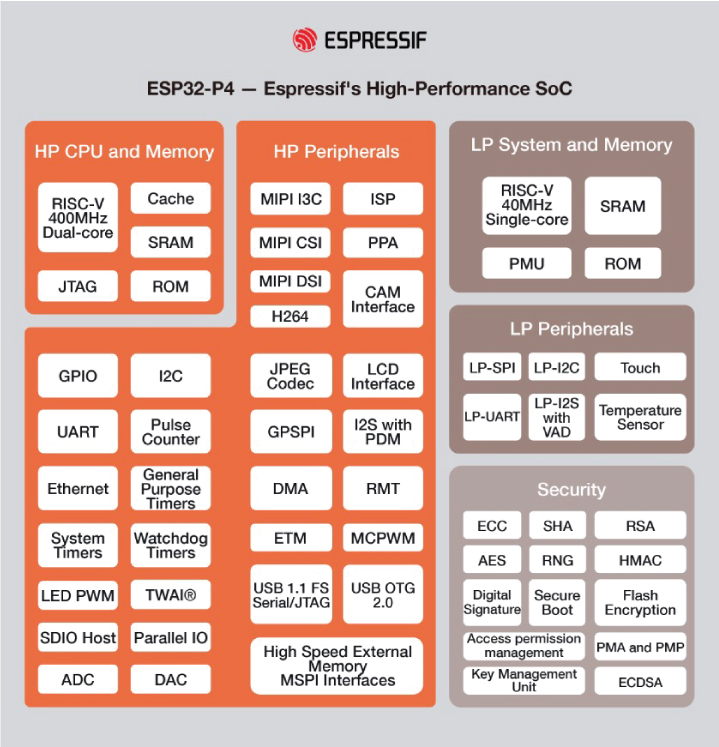
As in most other recent ESP32 cores, the main CPU is of the RISC/V type. Particularly, the chip comes with two cores which can reach a maximum speed of 400 MHz - of course, clock scaling can be applied to reduce current consumption. AI applications are aided by a group of expansions to the chip. An FPU ensures that floating-point computations can be accomplished at speed. In terms of memory arrangement, the ESP32-P4 provides increased flexibility for large-memory ESP32 applications. The local RAM is 768 kilobytes in size, and can be supplemented by external PSRAM if more memory is required. In addition to that, an 8kB local cache can be used for storing variables which are required in tight loops where memory access waitstates impact compute performance. The preliminary data sheet found at https://www.erlendervik.no/ESP32-C5%20Beta_ESP32-P4_ESP8686_ESP32-C3FH4X/ESP32_P4_Chip_Datasheet_V0.1_PRELIMINARY_EN.pdf, furthermore, informs about the existence of the SKUs ESP32-P4R16 and ESP32-P4R32 - one has 16 MB of on-chip PSRAM, while the second one has 32.
In addition to these two cores, Espressif provides the LP core system. This is a special version of the RISC/V-core optimised for low power consumption. While its maximum speed is 40MHz, it can reduce power consumption and permits designs to power off the HP cores if they are unneeded. This requires specific circuit design - not all peripherals of the P4 are accessible in LP mode.
Strong peripheral complement for efficient hardware interconnection
The ESP32-P4 provides space for a total of 55 GPIO pins - the most GPIO's ever found on an ESP32. A wide variety of hardware-accelerated peripherals accessible using the well-known ESP_IDF interface or, alternatively, the ESP32 Arduino core.
A particular focus of the ESP32-P4 is the driving of rich visualisations. This is supported by the presence of a wide array of HMI interfaces:
- 1 × MIPI CSI-2, 2-lane x 1.5 Gbps
- 1 × MIPI DSI, 2-lane x 1.5 Gbps
- 1 × 24-bit LCD parallel port
- 1 × 16-bit CAM parallel port
- JPEG Codec
- Image and voice processing interfaces
- Pixel processing accelerator (PPA)
- 2 x GDMA controller
- 1 x DW-GDMA controller
- 1 x 2D-DMA controller
Coding and decoding image data is a compute-intensive task. In the case of the ESP-P4, Espressif addresses this by providing hardware-accelerated codecs. When using the APIs implemented in ESP_IDF, the files are handled by these hardware units, leaving the HP cores free for compute tasks. Finally, the ESP32-P4 can be connected to all kinds of cameras, thereby permitting the running of ML vision tasks.
ESP32-P4-Function-EV-Board - a high performance evaluation board for visualisations
Espressif’s GUI stack of choice is the Hungary-developed LVGL, which has established itself as a standard for all kinds of GUI driven application on ESP32. In the case of the ESP32-P4, which currently exists as preliminary silicon, a high quality evaluation board is provided in the form of the ESP32-P4-Function-EV-Board.
One particularly impressive aspect is the way Wi-Fi and Bluetooth is handled. On careful observation, an ESP32-C6 wireless module can be seen on the top right corner of the board - it acts as a connectivity co-processor to the ESP32-P4.
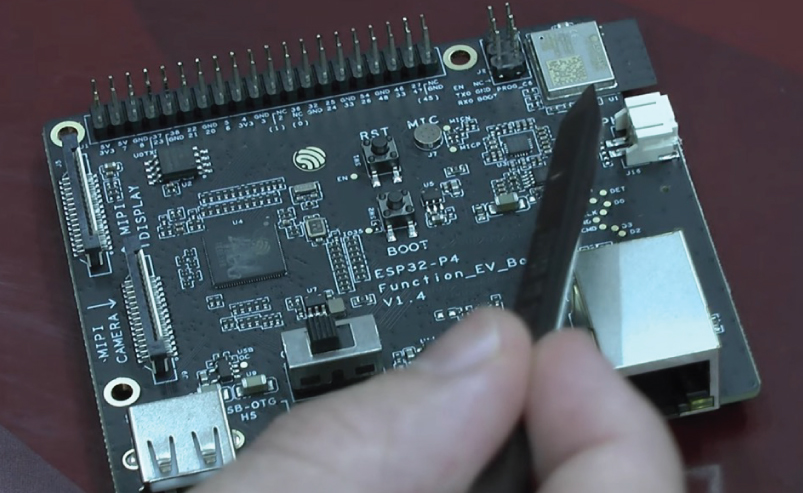
Finally, the high-quality screen of the development board deserves a mention. Combined with the graphical accelerators mentioned above, the LVGL performance is superior - more information can be seen in the video found at https://www.youtube.com/watch?v=12f7SJIcGG0.
Conclusion
With the ESP32-P4, Espressif launches a competitive contender in the general-purpose compute market. Developers who are deeply familiar with the ESP_IDF environment can now use their skills on a non-wireless processor with improved performance.