Industrial Computing Made Simple With The Raspberry Pi Compute Module 5
Traditional Raspberry Pi Compute Modules came in the DDR2 SO-DIMM form factor: while this meant that vibration-robust sockets were easily available, the amount of pins limited interfacing possibilities. With the CM5, a new connector layout enables the exposure of additional interfaces including a PCIe port for high-speed data transmissions.
The most important change concerns the construction. The new version of the Raspberry Pi Compute Module presents itself as shown in the figure.
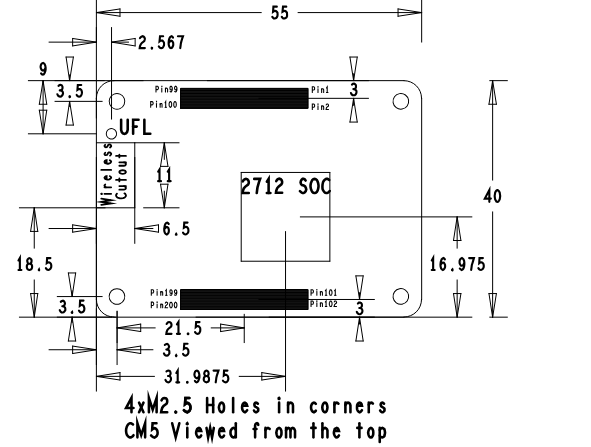
The black blocks at the top and at the bottom are a connector interface intended to mate with board-to-board-connectors made by Amphenol. In particular, the 10164227-1004A1RLF can be used to provide a clearance of 5 mm. If less clearance between application and compute PCB is required, the 10164227-1001A1RLF SKU is to be used in accordance to the data sheet found at https://datasheets.raspberrypi.com/cm5/cm5-datasheet.pdf. This document furthermore provides guidelines for optimizing antenna efficiency. In practice, using an external antenna is recommended if high performance is needed in the 2.4 GHz band.
200 Pins of Connection Flexibility
As mentioned above, Raspberry Pi Trading changed the connector topology in order to gain access to additional interface pins.
In the case of the Raspberry Pi Compute Module 5, the most outstanding capability is the presence of a gigabit ethernet interface along with a one-lane PCIe connector. It is specified to generation 2 of the standard, which leads to 5 Gb per second of raw transfer rate. In addition to that, up to 30 GPIOs are available; they can be configured in accordance to the following interfacing possibilities:
◦ Up to 5 × UART
◦ Up to 5 × I2C
◦ Up to 5 × SPI
◦ 1 × SDIO interface
◦ 1 × DPI (parallel RGB display)
◦ 1 × I2S
◦ Up to 4× PWM channels
◦ Up to 3× GPCLK outputs
As for multimedia, the compute module has two HDMI 2.0 ports and two four-lane MIPI ports. Connection to remanent storage can be accomplished via an SDIO 2.0 interface - it, however, is provided only on the light modules, whereas the full versions of the product use these GPIO interfaces to connect the eMMC memory provided on the printed circuit board.
Hardware Options for Optimal Matching Between Compute Task and Compute Module
All versions of the compute module are powered by a BCM2712 SoC produced by BroadCom. Its quad-core ARM CPU is known from the Raspberry Pi 5, and has shown itself able to handle the most demanding of embedded computing tasks. Developers can select between various memory and remanent storage options. In particular, the RAM can be 2, 4 or 8 GB in size, while the eMMC memory can be 16 or 32GB in size. This leads to a variety of different SKUs.
For example, the CM5104016 has a WiFi transmitter, four GB of RAM and 16GB of eMMC memory. The CM5004016 has a similar amount of memory, but omits the wireless transmitters for simpler certification and lower cost of ownership.
Given that all versions of the Compute Module are electrically and mechanically compatible, designs can easily be scaled up if the module is found to be too small. Alternatively, embedded hardware development can also start assuming the largest variant of the model known under its SKU CM5108064 - if the embedded software comfortably fits into a smaller device, the scale-down is as simple as a small adjustment to the bill of materials passed to the electronics assembly house.
Conclusion
If a Raspberry Pi application is intended for industrial computing and requires high vibration resistance, the Raspberry Pi 5 Compute Module's versatile mounting options make it an automatic best choice. Thanks to the almost-complete commonality with the well-liked Raspberry Pi 5 ecosystem, developers can be sure that support is available via a wide array of community and industry professionals. In short, a Compute Module that should always be recommended and used.