Kingston SDCE - A Highly Reliable MicroSD Card for Process Computers
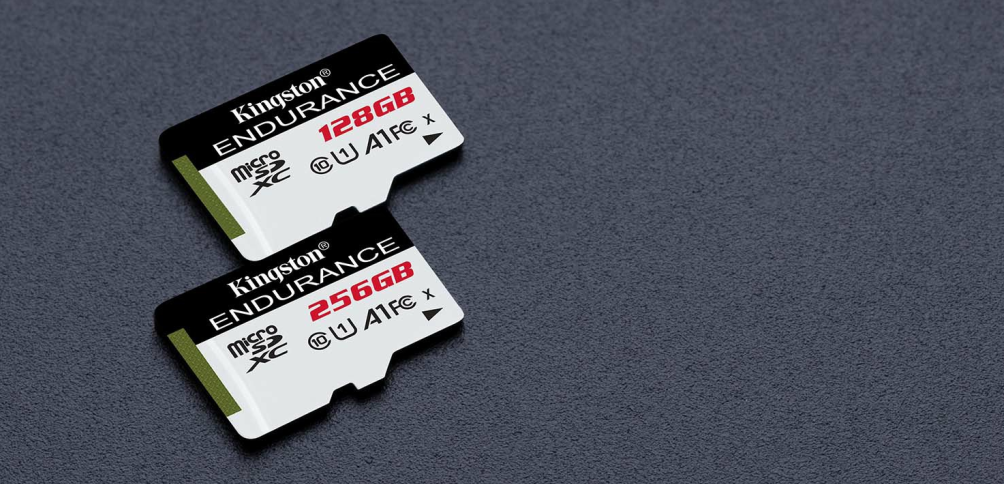
Frequent writing cycles cause flash memory cells to wear out. Single board and process computer applications tend to cause significant writing loads during their operation -- if high reliability and longevity are needed, the SDCE family shines brightly.
High-quality memory cards, such as the Kingston SDCE, address this problem through a variety of beneficial measures. Firstly, the flash memory cells are selected for high quality and longevity. Secondarily, the flash memory controller is provided with additional wear leveling intelligence, leading to a situation where bit fatigue can be mitigated by an intelligent distribution of the write load.
Certified for Non-Stop Video Recording
The most demanding of all tasks faced by a memory card is a recording system: video streams are notorious for their bandwidth consumption, leading to a significant and perpetual write load that does not give the flash cells time to cool.
In the case of the SDCE, Kingston promises that the memory cards are certified for 24/7 recording over a period of three years. The data sheet assumes that the following video encoding parameters are used:
Based on Full HD (1920×1080) video content recorded at 13 Mbps video support with video compression.
This leads to an impressive 27,000 operating hours -- if the card is confronted with a lesser write load, card life will be significantly increased.
High-Speed Reads and Writes.
Kingston's high-reliability microSD cards are certified by the UHS-I Speed Class 1 (U1) standard. In terms of reading, all four SKUS offer a speed of 95 MB/s, ensuring that complex operating systems can boot fast. Writing rates of 30 MB/s for the 32 and 64 GB models, increased to 45 MB/s for the larger models, make dumping large amounts of time-correlated data easy.
Finally, the card is certified to survive up to 3,000 program/erase cycles - this can be helpful if the system frequently performs program/erase cycles to comply with data security regulations.
Environmentally Robust MicroSD Card
Robust flash memory alone is not what makes this memory card unique. The operating temperature range spans from -25 to +85°C, thereby ensuring that challenging environmental conditions such as the desert do not cause data loss. Furthermore, the card is robust against x-rays and humidity - in the case of the water and radiation resistance, the data sheet promises the following;
IEC/EN 60529 IPX7 certified for protection against continual water submersion up to 30 minutes and depth up to 1m. Withstands temperature range from -25°C to
85°C. Protected against X-ray exposure based on ISO7816-1 guidelines
Finally, Kingston provides a reliability monitor application. It can be used to get an accurate assessment of the remaining lifetime of the card, thereby enabling targeted maintenance of process computers before issues arise.
Four Memory Sizes Are Available
As the memory demands of embedded systems continually rise, some Linux-based systems can operate with a comparatively small amount of memory. Kingston Technology addresses this via a total of four SKUs: the SDCE/32GB is the smallest, while the SDCE/256GB provides 256 GB of storage. SDCE/128GB and SDCE/64GB are intermediate sizes.
Conclusion
If a process computer design requires a memory card, do not use consumer-grade cards. Kingston's SDCE family is surprisingly affordable and offers excellent reliability and environmental robustness. In short, it is an absolute go-to card, even for that pesky digital camera.