LM3645 – LED Driver With An Integrated Boost Converter
White LEDs are used as camera flash even on the most affordable mobile devices. Powering them from a standard lithium-ion battery usually requires a dedicated boost regulator. With the LM3645, Texas Instruments provides a new chip that integrates both an LED driver and a boost converter.
Reducing the complexity of an application's power train can achieve cost and space savings. One classic approach is eliminating voltage levels---fewer voltage levels mean fewer converters and a lower cost for the resulting product.
Integrated Boost Converter for Higher Efficiency
Given Texas Instruments' vast experience in the design of switch mode and linear voltage regulators, the company decided to combine a boost regulator and an LED driver. Comfort features were also added, leading to the final application schematics shown in the figure below.
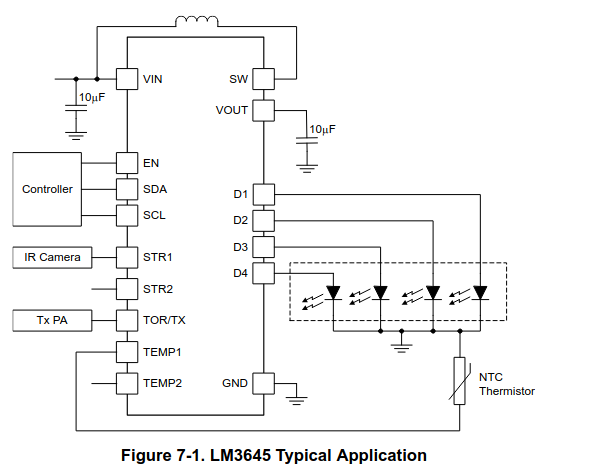
The most important part is the inductor enabling boost switching operation. Furthermore, two MLCC capacitors ensure that the voltage spikes do not cause EMI issues or otherwise troublesome effects on the rest of the circuit.
The I2C bus seen on the left-hand side of the figure communicates with the phone's SoC. It can access a wide variety of device registers, thereby permitting the modification of voltage levels, the amount of current to be driven through the LEDs, and many other attributes.
One interesting aspect concerns the presence of a temperature input---this can be used to directly attach to a thermistor, thereby providing a feedback loop to prevent overheating of the LED flashlights during prolonged use (such as recording movies).
The system can set current levels individually. If the LED complement constituting the device's flash does not consist of similar LEDs, each can be driven with the current that the manufacturer advises for optimal performance. Finally, the system permits torch mode, a special regimen where the LEDs are driven at a lower current, thereby reducing heat build-up when maximum light output is not needed for image recording.
Miniature BGA Housings for Size-Economy
Circuit designs using the Texas Instruments LM3645 can benefit from significant total size reductions. The layout below shows one example.
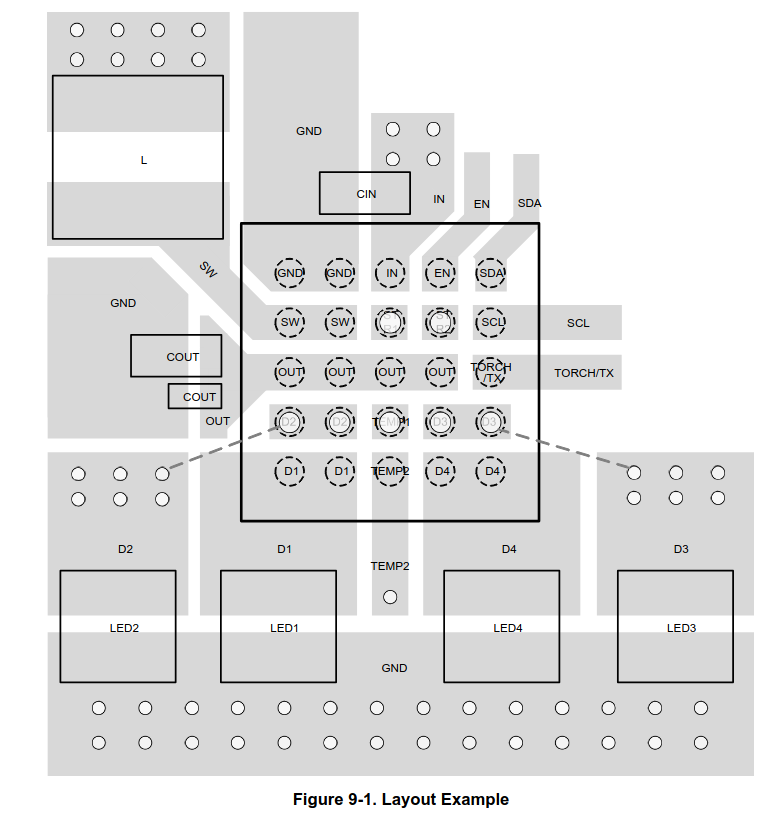
Thanks to the high switching frequency of 24 MHz, tiny inductors can be used. This means that weight increases are kept to a minimum, and component prices stay low.
Developers seeking a way to get started with the LM3645 are recommended to use the evaluation board, commonly available under the SKU LM3645EVM. It provides a breakout for the most important features and also comes with four onboard LEDs to permit direct system evaluation if the target system\'s printed circuit board is not yet finalized.
Conclusion
The trend in embedded systems is clearly toward smaller (faster, lighter) devices. With the LM3645, Texas Instruments provides an integrated LED driver ideally suited to developers facing this task.