MCX N94 - a high-performance artificial intelligence microcontroller
NXP's MCX family, as introduced at EmbeddedWorld 2024, marks the way forward for the firm. With the MCX family, developers gain access to high-performance microcontrollers that excel at accelerating all kinds of artificial intelligence tasks.
Two schools exist in terms of AI acceleration for microcontrollers. School one uses expanded instructions in the CPU core, while the other provides AI accelerator units in addition to the main core. In the case of the MCX series, NXP decided to deploy its eIQ accelerator, which is advertised to reach a top performance of 4.8 DP. In addition to that, a wide variety of peripheral devices ensure that data can be collected from various sensors.
MCX N9 versus MCX N5
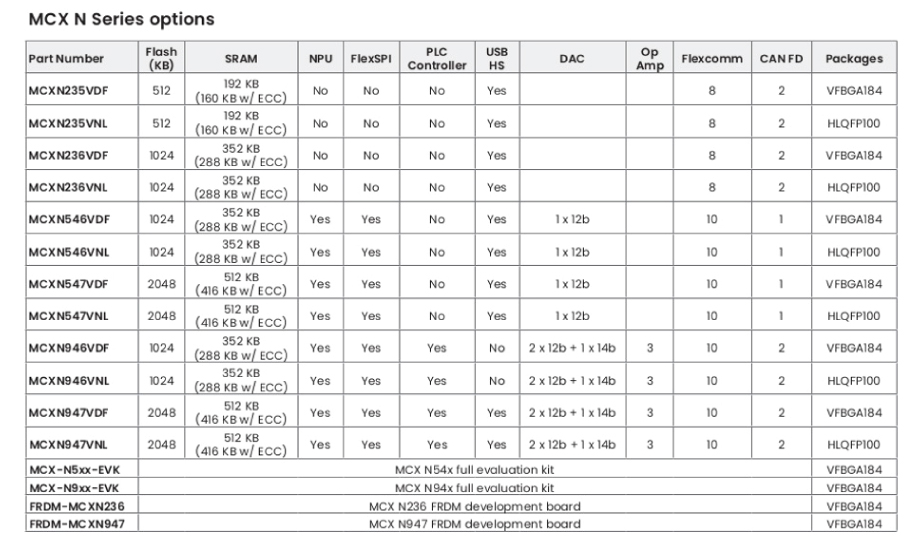
As of this writing, the MCX N microcontroller family consists of four main SKUs. The MCXN947VDFT SKU is the high-end model with the largest amount of memory and most analog peripherals. The MCXN946VDFT can be called a discount MCXN947, as it generally provides the same peripheral devices but a smaller amount of remanent storage.MCXN547VDFT and MCXN546VDFT provide a value-line version of the MCX ecosystem. Their main difference is a reduction in the number of analog peripherals.
The family's compute core consists of ARM Cortex M33 cores. The microcontroller provides two units that can reach 150 MHz. The data sheet claims 618 Coremark per core, leading to an impressive 4.12 Coremark points for each megahertz of clock speed.
Advanced options tailor chip selection to design needs
The casing of the NXP N series is currently being expanded. As of this writing, the VFBGA series is fully qualified, while variants such as the MCXN947VNLT, which ship in an HLQFP package, are pending final qualification before they can be released.Another interesting aspect involves the provided set of interfaces. In addition to 2 FlexCAN transmitters, the family has two I3C interfaces, which can also be used to interface with I2C sensors.
Furthermore, the FlexIO interface can emulate both display and camera interfaces, simplifying the handling of all kinds of image information.
Example application: predictive maintenance with the NXP N94
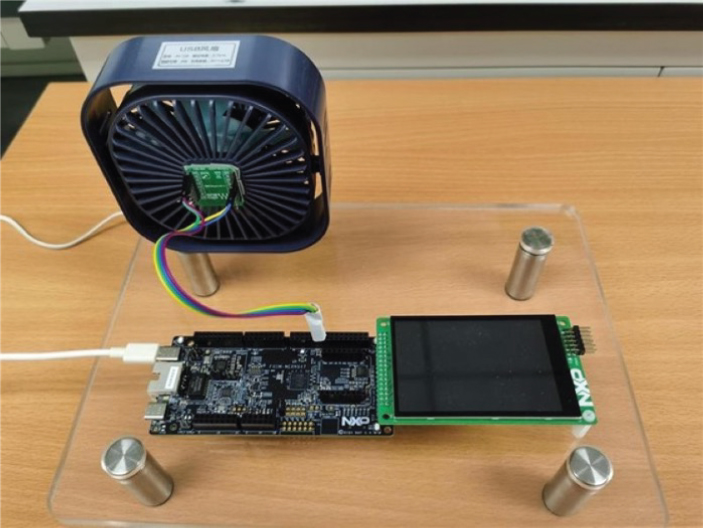
One fascinating example is the code found at the GitHub repository: https://github.com/nxp-appcodehub/dm-on-device-training-fan-anomaly-on-mcxn947. It uses an FXLS8974, which is to be connected in a vibration-tight fashion to the turbine of choice.
After that, libsvm is used to erect a support vector machine. This support vector machine can then analyze the motor status—an abnormal amount of vibration is, of course, an announcement of a failure.
NXP MCX N94 development boards
As in the case of many other embedded systems, NXP recommends that the design lifecycle start at the highest-end microcontroller. For this purpose, the FRDM-MCXN947 evaluation board is provided—it comes with a display and contains an MCX N94. ConclusionIf an application is intended to target only the N54, the MCX-N5XX-EVK development board should be used instead. However, it does not come with a display.
Conclusion
With the MCX N series, NXP provides a high-performance AI microcontroller that excels at general-purpose tasks. Developers working on AI applications are well advised to keep this component in mind. Furthermore, the availability of the free, Eclipse-based MCUXpresso IDE helps to keep development costs low.