Microchip PCI12000C - A Three-Port PCIe Switch With An Integrated GPIO Bridge
As the bandwidth demands of embedded systems increase, designers deploy PCIe connections in various scenarios. With the PCI12000C, Microchip launches a component designed to address common tasks in PCIe-based embedded systems.
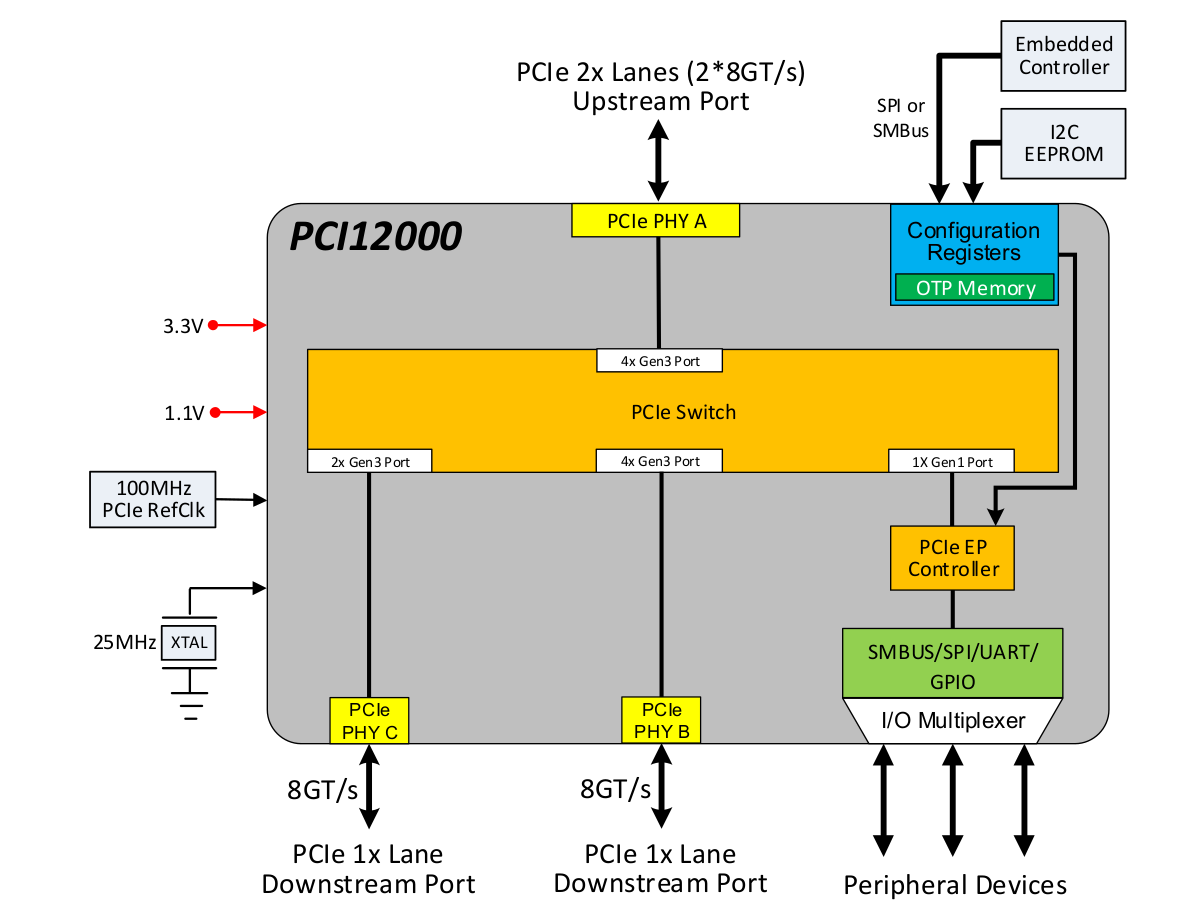
In principle, a PCIe switch - it acts similarly to the switch known from Ethernet - provides port multiplication for PCIe ports found in an embedded system. In the case of the PCI12000C, the upstream port operates with a bandwidth complement of 2 × 8GT, while the individual downstream ports each provide 8GT of bandwidth.
Simple System Integration
Microchip supports designers via SPI or SMBus interfaces for programming the pin mux. IO functions can be flexibly mapped across the package pins. This is extremely helpful because it enables PCB layout optimization, thereby eliminating signal integrity issues on high-speed serial buses. As an alternative to static configuration, an I2C EEPROM problem can be provided. The PCI12000C will read its contents during start-up and use them for a headless self-initialization.
One unique aspect of the PCI12000C is its capability to generate all required clocks internally. When provided with the 100 MHz bus master clock and a single 25 MHz crystal, the component automatically generates the remaining frequencies.
Flexible GPIO Mux With Industry-Standard Peripheral Interfaces
Embedded systems often profit from the availability of various control buses. This way, the individual PCIe client devices can receive additional control signals to modify their behavior to the tasks at hand.
In the case of the PCI12000C, designers can reduce the total cost of ownership by using the integrated GPIO system. It can be used as an I2C-to-PCIe bridge, an SPI-to-PCIe bridge, a UART-to-PCIe bridge, or a simple PCIe GPIO controller. In all cases, Microchip provides industry-standard drivers that enable direct integration with the PCIe stacks in embedded and workstation operating systems.
Industrial and Automotive Versions Available
The PCIe bus is not limited to classic workstations. It is instead used in both automotive and industrial applications. Microchip addresses these by providing a variety of SKUs with extended temperature ranges.
Designers working on an industrial system that requires a temperature range of -40 to 85 degrees Celsius can, for example, deploy PCI12000C-I/ZUX. For automotive grade 2 (temperature range of -40 to 85 degrees C), SKUs such as PCI12000C-V/ZUXVAO should be used. The widest temperature range is then orderable via SKU PCI12000CT-I/ZUXVAO.
Conclusion
Integrating the GPIO interface functionality into the PCIe switch greatly reduces both PCB space and total cost of ownership. With the PCI12000C, Microchip provides embedded systems designers with a high-performance component dedicated to this task. It is available in a wide array of temperature grades, thereby ensuring successful integration in the most challenging of operating environments. In short, an extremely handy tool that is always worth considering.