PocketBeagle 2 – A Control Optimized BeagleBoard Single Board Computer
Even though combinatorial SoCs with real-time cores provide great latency response, adding a dedicated microcontroller yields the absolutely best results. With the 102110780, commonly known as PocketBeagle 2, the Michigan-based BeagleBoard foundation provides a single-board computer combining the best of both worlds.
American-designed, open-source-based, and TI-powered single-board computers can be useful in a variety of scenarios. With the PocketBeagle family, BeagleBoard offered a control-focused board family. One of the most important sales aspects of this product is the wide GPIO array, which makes adding external hardware simple.
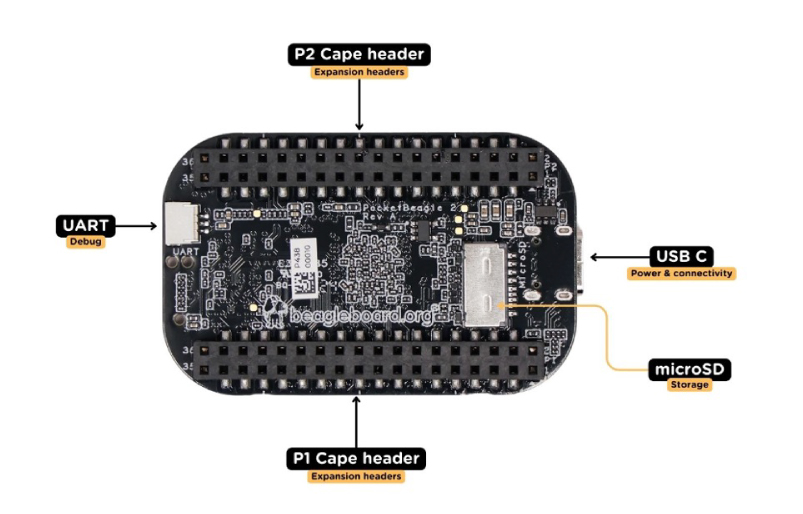
With the PocketBeagle 2, the winning formula receives a through-the-bench upgrade, improving all kinds of specifications.
Texas Instruments AM6232 - A Multi-core, Linux-capable SOC
The BeagleBoard Foundation traditionally used Texas Instruments SoCs made or designed in the USA. The impressive performance gains of the 102110780 are caused by an upgrade of its SoC, which is now an AM6232 chip found in the Sitara line.
In particular, the version at hand provides two Cortex-A53 cores, which run the embedded operating system. A third ARM Cortex-M4 core is dedicated to handling real-time control tasks. The components are interconnected inside the SoC, thereby ensuring that messages can be passed between the two domains with minimal delay.
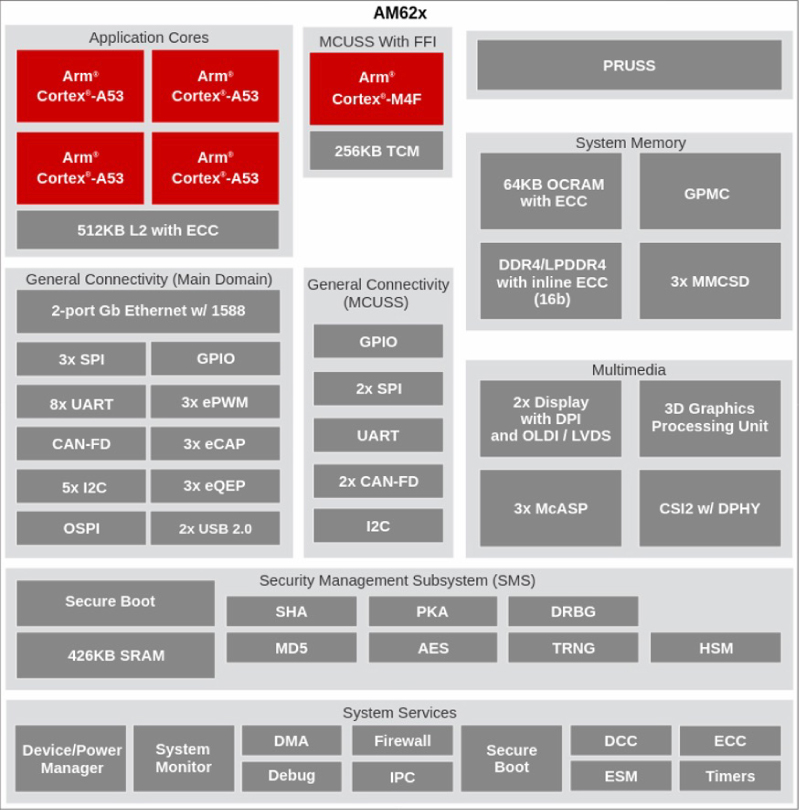
In terms of random access memory, the PocketBeagle 2 comes with 512 MB of RAM. This is enough for running all kinds of headless Linux distributions and leaves more than enough space to provide additional buffered memory. In particular, the memory chip used is provided by Kingston Technology and has the SKU D2516AN9EXGXN.
A microSD slot is provided for remanent storage. It can be loaded with a variety of industrial or consumer-grade memory cards, which can then be used to boot Linux in a fashion similar to the one known from Raspberry Pis and other single-board computers in the market.
A Standalone Microcontroller for Maximum Real-time Performance
Analog subsystems on SOC provide interesting challenges. The BeagleBoard foundation uses innovative ways to avoid the problem.
Their single-board computer comes with a dedicated MSPM0L1105 microcontroller, which - by default - is configured as a combination of an EEPROM for remanent data storage and 12-bit ADC with eight channels’ worth of input capability.
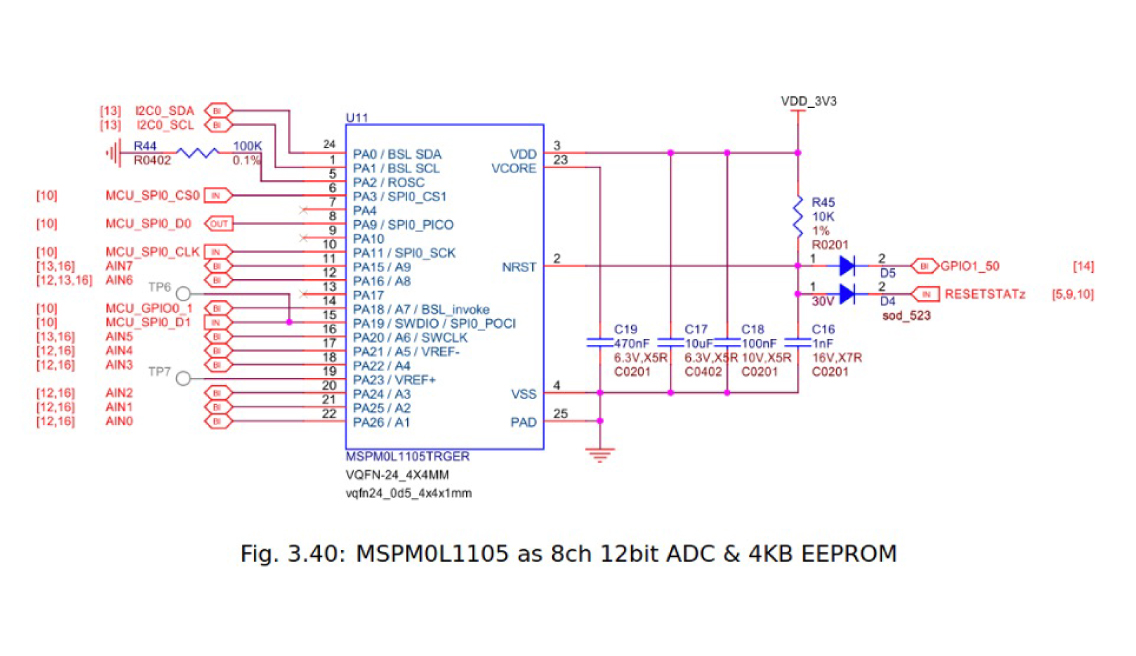
This approach gives embedded systems designers significant additional flexibility. Firstly, the controller can be programmed to house more or less arbitrary firmware, thereby ensuring that motor control and similar tasks are completely independent of the embedded Linux distribution used for the main single-board computer.
Alternatively, the PocketBeagle 2 could be used as a teaching tool to learn more about microcontroller programming. Finally, the controller with some additional circuitry—can also be used to implement designs similar to those outlined in application note AN4121.
Excellent Documentation and Open-source Schematics
The strong educational background of the BeagleBoard Foundation manifests itself in the availability of excellent technical documentation for almost all of its single-board computers. In the case of the PocketBeagle 2, the PDF file found at https://docs.beagleboard.org/pocketbeagle-2.pdf deserves special attention - it provides a detailed overview of the periphery and also shows the schematics used to achieve the individual bits of functionality.
Conclusion
With the PocketBeagle 2, BeagleBoard takes a winning concept and upgrades it using the latest technology from Texas Instruments. If a headless embedded system is to be designed, the 102110780 surely should be one of the first single-board computers considered.