Raspberry Pi Pico 2 W – Wireless RP2350, The Raspberry Pi Way
With the RP2350, Raspberry Pi Trading improved its microcontroller family in all regards. The Raspberry Pi Pico 2 W is an official evaluation board containing both the new microcontroller and a wireless module. Thanks to the large community around the Raspberry Pi Pico platform, it will surely be a smash hit.
Microcontroller introductions by Raspberry Pi Trading have usually followed the same pattern. In the first step, a basic evaluation board - in the case of the RP2040, it goes by the SKU SC0915 - is introduced.
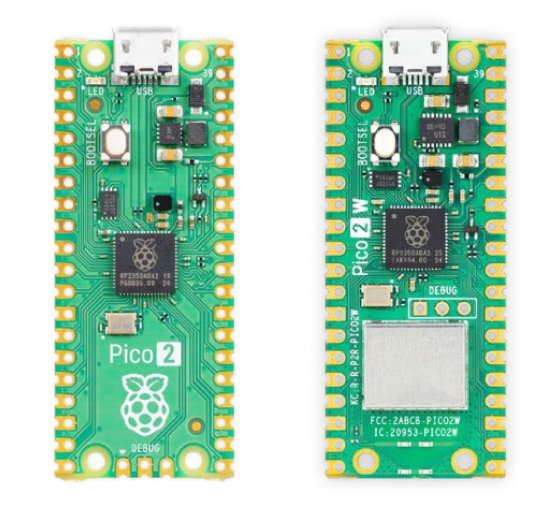
After that, an advanced and slightly more expensive version bearing an external wireless module is delivered in a similar form factor. In the case of the RP2350 (discussed in detail at https://www.oemsecrets.com/articles/raspberry-pi-rp2350-powering-the-next-generation-raspberry-pi-pico-2 and https://www.youtube.com/watch?v=pqecXDrHhpg), this has just taken place under the SKU SC1633. As can be seen in the figure, the Pico 2 and the new Pico 2 W have a very similar form factor - the main difference involves the placement of the debug connector.
Wireless Module: Compatibility Is Everything
For the first generation wireless Raspberry Pi Pico, Raspberry Pi Trading enlisted the help of Infineon. Their wireless module CYW43439 will also be used on the successor - thanks to the similar design, the module will work with environments such as MicroPython without much adaptation.
In terms of provided wireless standards, the module enables both Wi-Fi and Bluetooth support. The module is fully documented at https://www.infineon.com/cms/en/product/wireless-connectivity/airoc-wi-fi-plus-bluetooth-combos/wi-fi-4-802.11n/cyw43439/; the figure below provides an overview of the various components found inside.
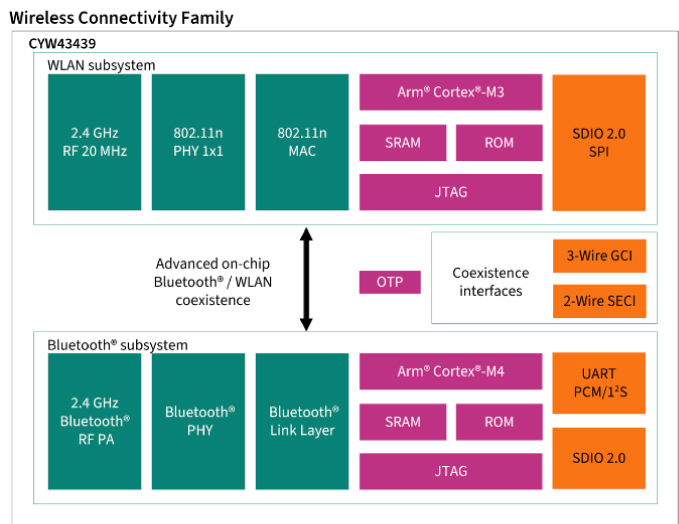
Incidentally, Raspberry Pi Trading also works on a module called RM2—it is said to be extremely similar to the one used here, thereby providing a smooth upgrade path towards further professionalization.
Modem Certification Reduces Certification Cost
Studying the documentation of the Raspberry Pi Pico 2 W in some detail reveals the passage shown in the figure below. Raspberry Pi Trading had the board certified by a wide variety of industry standardization bodies listed at https://pip.raspberrypi.com/categories/1090-approvals.
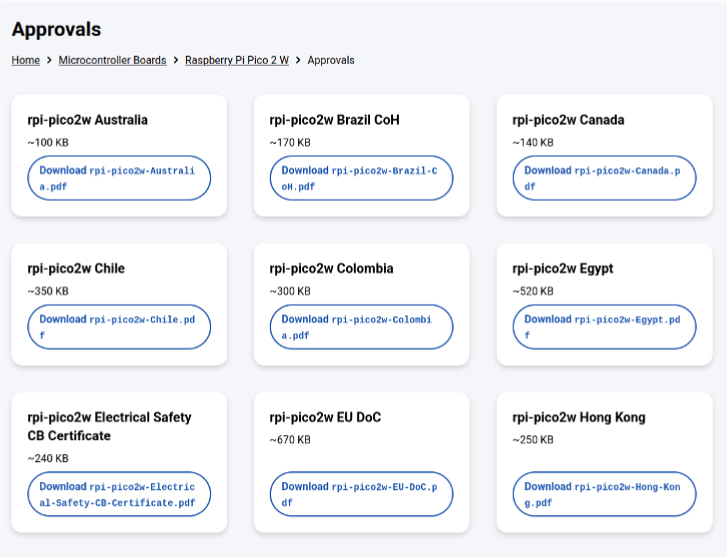
This means that an end product using this Raspberry Pi can undergo an abridged path to final certification. While this does not mean that the total certification costs are zero, a significant reduction can be achieved as the intentional emitter certification can, by and large, be ignored.
Finally, the RP2350 is covered by the Raspberry Pi longevity promise. This means that the manufacturer commits to maintain production until January 2040. Challenges caused by microcontroller discontinuation will surely not occur on this system.
Conclusion
If a microcontroller system based on the RP2350 microcontroller requires a wireless module, using the Raspberry Pi Pico 2W is a smart and economically sensible approach. The large community ensures that the wireless module is supported by most embedded software SDKs—getting started is thus greatly simplified.