ROHM ML63Q2500 Solist - An Innovative Approach to The AI Microcontroller Topic
With the Solist-AI microcontroller family, ROHM Semiconductor introduces a series of microcontrollers that combine an ARM Cortex-M0+ core with a custom AI accelerator module. They enable the execution of predictive maintenance tasks with minimal power consumption.
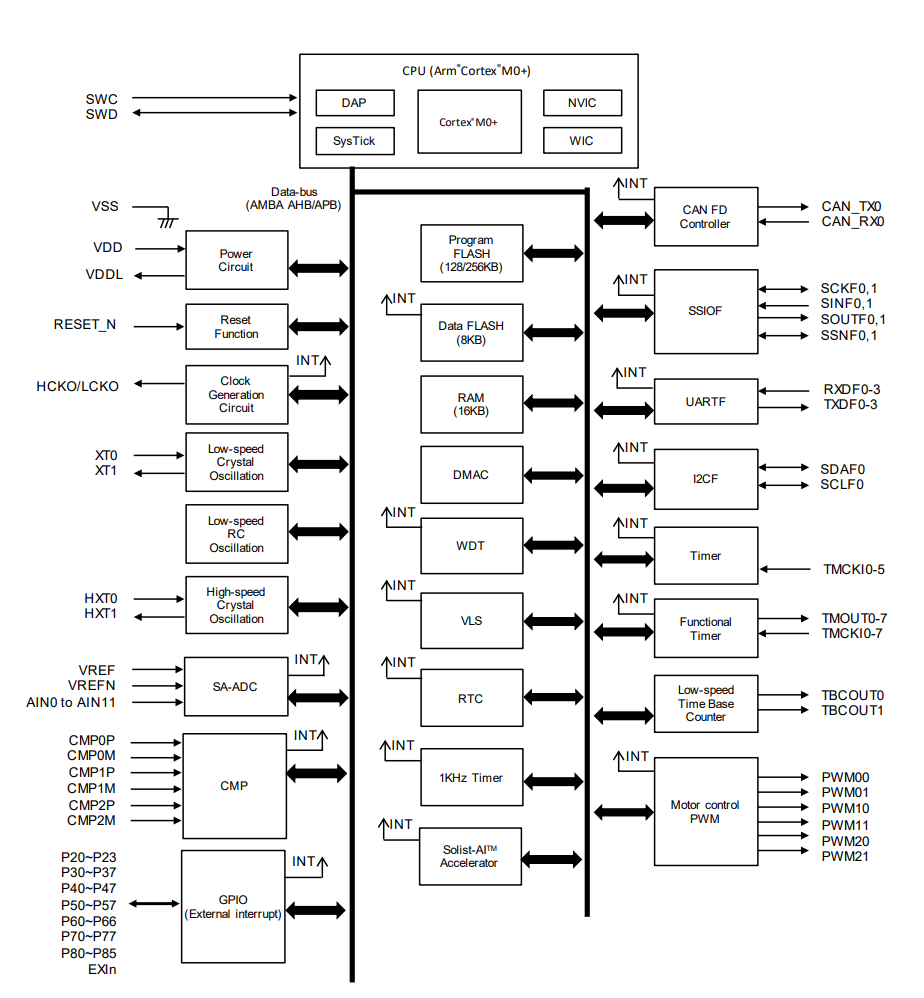
AI microcontroller designs broadly fall into two schools: the first one uses an AI-enhanced microcontroller core such as the Cortex-M555, while the other one comes with a dedicated AI accelerator module. Both designs have their benefits - with the Solist family, ROHM firmly bet on Team Two. This decision leads to the structogram shown in the figure below.
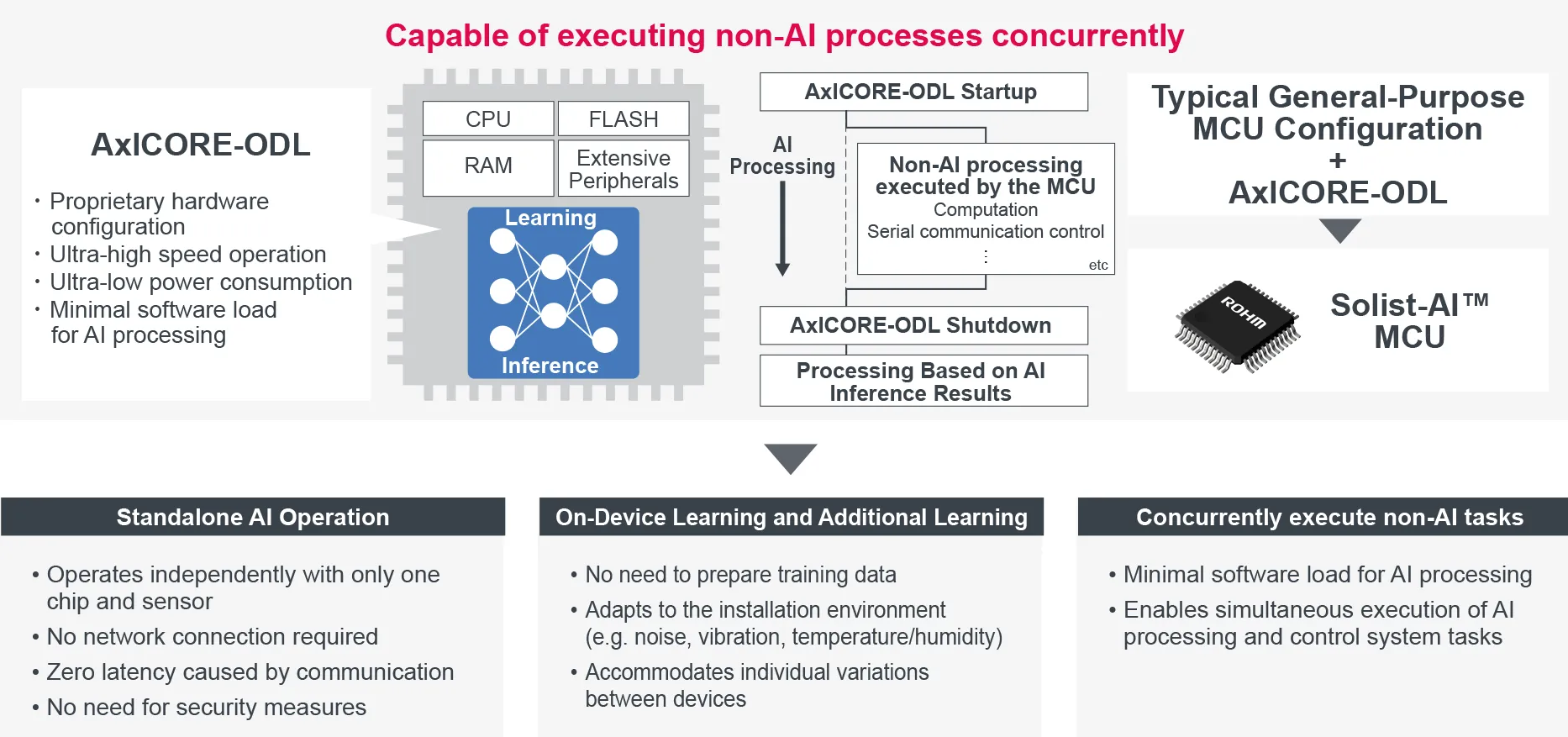
The ARM Cortex-based core acts as a hypervisor and managing instance: it runs the main application code, which can outsource AI-related computations to the Solist accelerator shown at the bottom of the diagram.
Core Off-Load for Tasks Related to Artificial Intelligence.
Interaction with the Solist engine is done via a classic load-and-harvest strategy. The ARM CPU deposits the values to be processed into special registers and starts the conversion process. Sometime later, the CPU should check back to harvest the results -- alternatively, an interrupt can be fired after the AI computation has run its course.
As for the operations that can be accelerated, the datasheet claims the following:
- Addition, subtraction and multiplication of scalars, vectors, and (non-square) matrices are possible.
- Enables FFT calculation processing useful for vibration sensor data processing.
- Calculations can be executed without CPU load.
- Data format: bFloat16 (Built-in integer to bFloat16 conversion function.)
One impressive aspect of the accelerator is ROHM's claim of on-device training capability. Developers can use harvested model data directly on the microcontroller. Information does not need to be exported to the PC for analysis and model creation, thereby enabling an accelerated time to market.
Ecosystem Support for AI Task Development
ROHM supports developers with its own Eclipse CDT-based IDE called LAPIS Development Tools. Furthermore, the URL https://www.rohm.com/support/solist-ai provides access to software utilities, including Solist-AI Sim and Solist-AI Scope. These programs connect to a Solist MCU and simplify the AI development process by exposing parameters relevant to algorithm designers. ML63Q2534-NNNGDZW has formed partnerships with various AI companies to provide pre-optimized models for common embedded AI use cases.
Finally, ROHM provides a variety of SKUs for their latest AI microcontroller. SKUs such as are packaged in a 48-pin plastic WQFN case, while ML63Q2534-NNNTBZWA and others yield TQFP packaging.
Conclusion
If a high-efficiency AI microcontroller is required, evaluating the ML63Q2500 and other family members of the ROHM/Lapis Solist family is a good idea. Ecosystem support and hardware acceleration enable embedded engineers to tackle numerous industrial electronics tasks with minimal effort.