Silicon Labs CP2102C – A USB To Serial Bridge With A 3 Mbps Transfer Speed
Connecting digital electronics to USB usually requires a USB-to-serial bridge. With the CP2102C, Silicon Labs updates the venerable CP21xx family with a faster option.
USB-to-serial integrated circuits are a classic: when connected to the computer, they permit electronics to interface with the USB bus using a UART-based interface.
In the case of the CP2102C, Silicon Labs updates its widely supported (read: the drivers are often already on the target system) family of products with a new option enabling a maximum transfer speed of up to three Mbps.
From a technical point of view, the system will present itself as shown in the figure below.
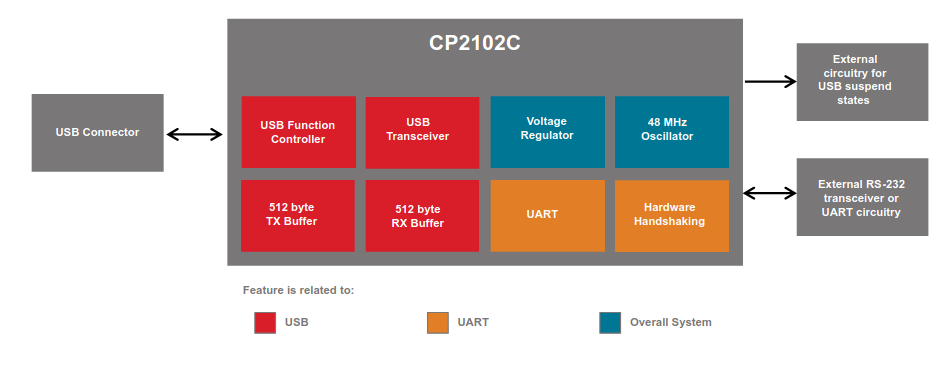 One outstanding aspect of the design is that it comes with an integrated clock oscillator: designs using the CP2102C can make do without the external crystal, which leads to space savings, cost savings, and an overall higher robustness of the resulting circuit.
Flexible Power Options
USB ports can source 5 V DC. In the case of the CP2102C, Silicon Labs permits the circuit designer to assess whether this power supply should also power the actual circuit.
Alternatively, the system\'s internal voltage regulator can be used---as shown in the figure below, it can handle a wide range of voltages.
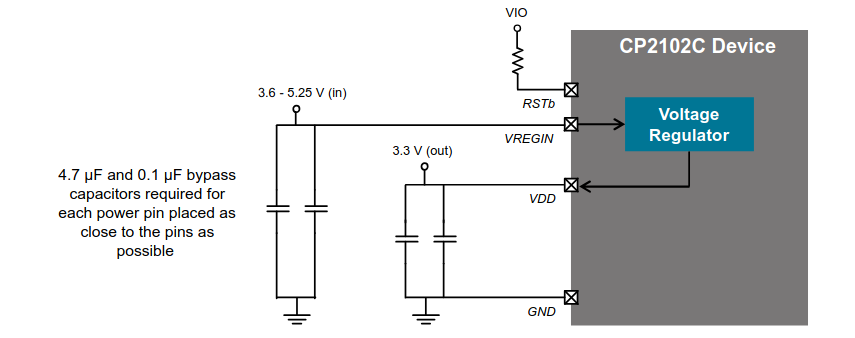
In addition, two surface-mount resistors and a few SP0503BAHTG diodes are recommended to increase the interface's robustness.
When done, the resulting USB-to-serial converter can operate at the high speed mentioned above. In terms of supported data formats, the system exhibits superior flexibility:
Data formats supported
• Data bits --- 5, 6, 7, and 8
• Stop bits --- 1, 1.5, and 2
• Parity --- odd, even, mark, space, no parity
• Baud rates: 300 baud to 3 Mbaud
• 512-byte receive buffer
• 512-byte transmit buffer
• Hardware handshaking supported
Should the receiving system support hardware handshaking via the RTS and CTS pins, this is also possible via the CP2102C. In this case, the lines need to be connected, and the host furthermore needs to activate a special regimen in the USB driver to ensure that the chip's hardware-handshaking feature protects high-speed communication.
Excellent Support, Wide Driver Availability
USB-to-serial bridges sometimes require the installation of a dedicated driver on the host hosting the USB port to communicate with the device. In the case of the Silicon Labs CP2102C, the drivers are supported by all recent operating systems, including most builds of Android - this means that the driver will, in many cases, already be in place on the target system.
Silicon Labs furthermore supports engineers getting started on the designs with ample documentation. To gain access, simply visit the documentation hub hosted at https://www.silabs.com/interface/usb-bridges/classic/device.cp2102?tab=techdocs. The individual documents can then be freely downloaded without prior registration.
Conclusion
If an affordable yet high-performance USB-to-serial bridge is required, the CP2102C definitely deserves attention. Not only can it exceed standard UART speeds by far, but the system can also adapt to just about any known serial protocol. Furthermore, the wide availability of drivers ensures that host system integration will be a non-issue---in short, it is a component that definitely deserves space in your bill of materials.