STMicroelectronics MLPF-WL-0xD3 - Matched Antenna Filters for The STM32WLx Microcontroller Family
Antenna matching requires a vector network analyzer and can become an interesting task. With the MLPF-WL-0xD3 family, STMicroelectronics provides developers with a turnkey solution to the problem.
Matching circuitry is a P or T filter, usually consisting of three passive components. In day-to-day engineering, an almost finished product is analyzed to determine the resistor, capacitor, and inductor values best suited to the three passive element slots in the circuit. This process, however, can be expensive and takes a lot of time.
ST MLPF-WL-0xD3 - Ideally Suited to the WLx Family
With the STM32WL family, STMicroelectronics integrated its Bluetooth and wireless microcontrollers into the well-liked STM32 ecosystem. This means that wireless software development can take place in the STM2CubeIDE, while the peripheral device drivers from non-wireless microcontrollers can mostly be reused on the wireless versions.
STMicroelectronics provides three different SKUs for filtering. MLPF-WL-01D3 is intended for 16dBm output power in the band from 826MHz to 958MHz, while MLPF-WL-02D3 works best at a power setting of 20dBm. Finally, MLPF-WL-04D3 wants a power level of 16dBm and a working frequency of 413MHz to 479MHz.
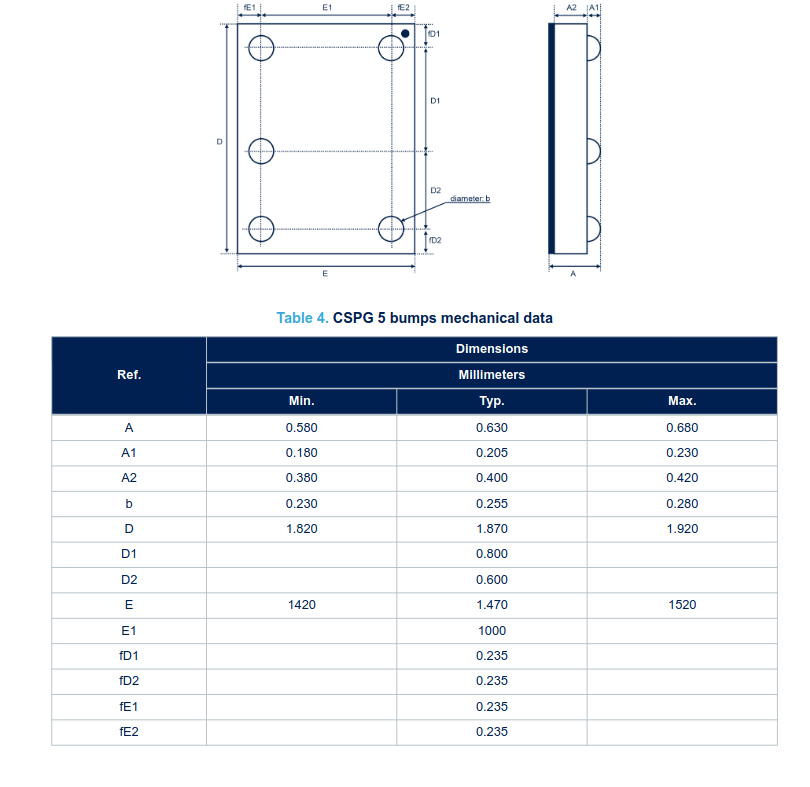
Regarding casing, the integrated circuits consist of a four-layer PCB and follow the outline shown below.
In principle, they are switched between the STM32 microcontroller and the RF antenna, ensuring optimal conditions exist for high-range transmission and reception of all kinds of wireless signals.
Interestingly, the products shrink during reflow soldering. In the data sheet, STMicroelectronics promises a total profile height of about 630 micrometers once the printed circuit board has passed through the reflow soldering process.
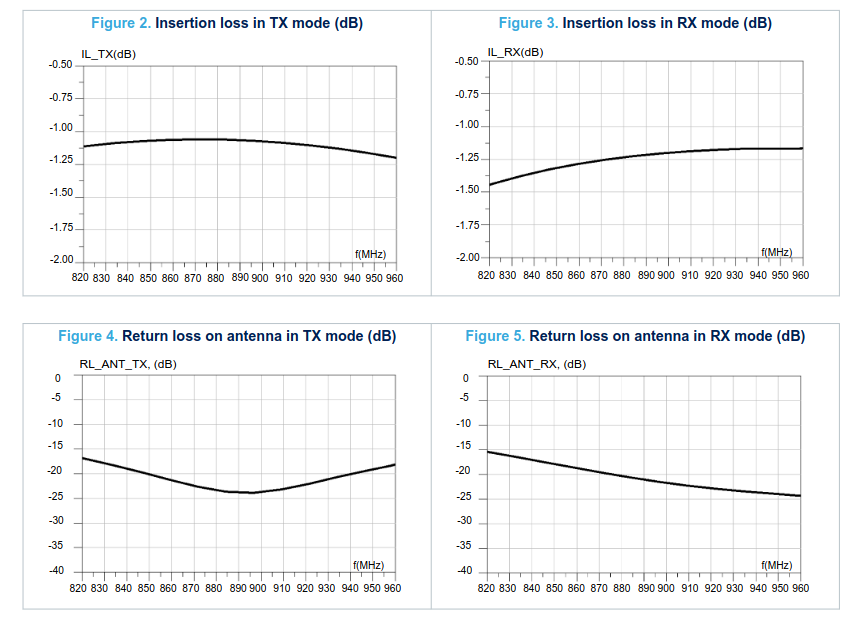
The RF parameters of all three parts are first-grade. The figure below shows the insertion and return losses for the MLPF-WL-02D3. Similar figures can be found for the two other SKUs by consulting the respective datasheets.
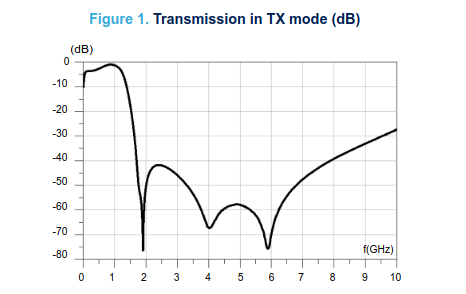
Wide-band transmission filtering is also excellent. The below was also taken from the data sheet of the MLPF-WL-02D3 and shows that EMI rejection is high due to the accurate performance of the filter.
Finally, the MLPF-WL-0xD3 family is fully compliant to the Ecopack2 directive: meeting environmental certifications is simplified, and the various components of the RF BOM do not need to undergo certification or qualification on a per-component level.
Conclusion
If a product based on the STM32WB wireless transmitters requires antenna matching, using the MLPF-WL-0xD3 leads to the best results. As the wireless SOC manufacturer, STMicroelectronics has access to the most accurate models of transmission and reception paths. This knowledge is used to achieve optimal radio frequency design.
The MLPF-WL-0xD3 family is attractive due to its low price and extremely small casing. Antenna filters made up of individual passive components occupy more space on the printed circuit board and add to the pick-and-place cost because of the requirement for three placement operations. In short, this is a component that is recommended in all circumstances.